Showing posts with label furnaces. Show all posts

Friday, March 1, 2013

Three Essential Spring Furnace Maintenance Tips


Spring furnace maintenance is really all about making sure your furnace is in good shape for next fall/winter. It also ensures that when it's time to turn on your air conditioning in the summer, your system is ready to go.
A majority of Canadian households run their furnaces from October to March or April. That's about 6-7 months of furnace use, on average. Those who have HVAC systems that produce both heat in winter and cool air in summer run their systems nearly year-round.
No matter what kind of system you have at home, the constant use means wear and tear on parts. Running a furnace or HVAC system is just like running a car: the more you use it, the faster it will wear out. This is why your system needs regular maintenance, just like your car does.
Your system should be "tuned up" at two critical points each year: pre-fall/winter (before you need to use your heat) and spring (when you transition from using heat to turning off your furnace and using your air conditioning). Here's what you should be focusing on in the spring:
1) Pressure wash the outdoor condensing unit or heat pump. Spring is the best time to do this. Wait until the weather has warmed up and you're certain that you won't be using your heat again until the fall. Pressure washing of this component removes winter grime and bits of gravel that frequently get caught inside of parts during the cold, wet and slushy weather. It also helps to loosen up and remove dead leaves that may have gotten caught in its parts. A clean system runs more efficiently. Plus, you're less likely to incur damage to parts from all those bits.
2) Check your filter. Your furnace filter needs to be replaced approximately every 3-4 months when you are regularly using your system. Here are some general tips on how to decide whether you need to change the filter or not:
* Is the filter visibly dirty or clogged? If you can see bits of dust and debris in it, it's a good idea to change it. If dust and debris is minimal and you don't plan on running your system for a few months, you can opt to change it before you turn it on in the fall. Just don't forget! If there's a lot of debris in it, go ahead and change it now.
* Check the color of the filter. Filters may be white, gray or cream-colored. Even if there is minimal visible debris caught in the filter, you should change it if the color of the filter has changed/darkened.
* When you replace the filter, write the date on the new one in permanent marker. This way you'll know for certain whether you've been using it longer than three or four months.
* If your filter has been in use for more than four months, change it even if it doesn't seem very dirty. Not all debris can be seen, and your furnace will perform more efficiently with a clean filter.
3) Get your system inspected. You should do this at least once per year. If you do it in the fall, it may not be necessary to do it again in the spring.
However, spring is an ideal time to attend to this task. This way you won't freeze if it turns out that there is something wrong or if a part needs replacing. Few things are worse than waiting until the first cold snap of autumn to turn on the furnace, only to discover that it's not working, and now you're stuck with no heat while you wait for a new part to be ordered and installed.
For the same reasons, spring time is a great time to replace an old furnace or HVAC with a new one. Replacing a furnace usually takes some time, anywhere from days to weeks. Doing it in spring means you won't go without heat and air conditioning during other times of the year when you really need it.
Sandium Heating and Air Conditioning is your spring furnace maintenance specialist.

Friday, December 7, 2012

5 Tips To Winterize Your Home


1. Tune-up the heating system
 
As you probably know from the previous winters, approximately 30% of the household expenses during the cold season stem from the heating system. On a side note, based on the region you live in and the resource you utilize for heating - mainly electricity, gas and oil - this expenditure could easily double. Therefore, it is highly advisable to test their functionality, check for faulty devices, change filter systems and perform any other maintenance tasks to ensure they are in top working condition.
 
2. Check the insulation on the ductwork
 
Without properly insulating the ductwork that runs all across your house, you risk wasting about 60% of the heated air by trying to maintain a comfortable temperature indoors. If you're tired of wasting so much money, then it would be a good idea to insulate the ducts, particularly in the cold areas of one's house such as the basement, attic or crawlspaces. In case you observe pinches and gasps, then utilize a metal backed tape to fix them. Even though regular duct tape can do the trick in most cases, it won't be as efficient if you have an older ductwork. Don't forget to wrap up the pipes that run outside your house as well.
 
3. Button up the home windows
 
Ideally, winterizing the windows would imply replacing the current home windows with resilient storm house windows as their extra layer of protection works great on keeping the warmth inside the house. However, if you can't afford to spend money on new home windows, there is still a viable solution for your personal situation, namely insulated blinds. While many homeowners don't give them too much credit, in reality the insulated blinds have the potential of doubling or even tripling a window's efficiency level.
 
4. Block the air leaks
 
Did you know that air infiltration is the number one reason for the low temperatures at your residence? However, air leaks are simple to handle as all you need to do is walk around with a smoke stick to  discover and block them. Getting door sweepers and caulking the doors and home windows is usually an easy trick to prevent cold air from making its way into your house.
 
5. A programmable thermostat would really come in handy
 
Since you want to keep the heating bill from eating into your bank account too much, it would be wise to spend money on a programmable thermostat that will turn the heating system on and off according to the desired interior temperature.


Wednesday, November 28, 2012

Furnace Buying Tips


The furnace is the most important appliance in your home- just ask anyone who is without a working furnace during the dead of winter. So how do you go about choosing the right furnace? Here are some tips to keep in mind:
 The specs of the furnace must meet your needs exactly. If it is to small it will not heat your home effectively, and too large will run too frequently- thus raising your utility bill, wearing down parts to quickly, and creating a temperature in the home that is uncomfortable. Not to mention if your air ducts are designed for a smaller furnace than the one you purchased, the flow of the air would be loud throughout the house and cause excessive wear on the ductwork.
• Choose a well-known and trusted contractor to purchase from and install your furnace. Some companies may try to sell a unit that is more than what you need just to make an extra profit. You want someone with experience that will come out to your home and evaluate what you really need. 
• Consider energy efficiency.  Check out the furnace's annual fuel utilization efficiency rating. This is a % that will tell you how efficiently it uses energy. This number is common among gas furnaces.
• Think about the various options that are available on furnaces, make a list of wants and needs. You may want to consider getting variable speed blowers on your furnace so that the air moves through your home slowly. This will create less noise at times when not as much heat is neede. It also results in fewer problems with keeping the temperature at a comfortable level inside your home. Variable heat outputs and air filtration devices are also features you should look into.
• Most often it will actually save you money to replace your furnace earlier rather than later. Old furnaces do not operate at the level of energy efficiency that those made today do, so you might want to consider replacing an old furnace simply because of its age.
If you're unsure whether you should repair a furnace or if replacing it is the better option, call in a trusted technician to evaluate the  furnace. It could be as simple as changing out a filter or if a main component has gone out then you will need to replace it.

Tuesday, November 13, 2012

Getting Your Furnace Ready for the Winter Weather


November is here, the cold weather season is upon us. In fact many of us are already dealing with snow and freezing temperatures. This is the season that many people love. I mean who doesn't long for the brisk chill of a cool November day? Cold weather, cuddling by the fire, hot chocolate..  That said- winter has a way of sneaking up on us.  As a result, it's imparitive to take quick action to ensure that your home is a warm, comfortable living space during what could be a very cold winter.
Neglecting your hvac system can lead to disastrous results. If you aren't careful your living room could turn into the Arctic Circle. The cold weather, as much as we love it, belongs outside. You look forward to the wondrous benefits of winter: hot cocoa, crackling fire in the  fireplace and family gatherings. Well, in order to enjoy these traditional winter activities you should make sure that your heating system is serviced and running properly.
If you have a older, outdated heating system whether it has performed wonderfully or questionably, have it inspected soon. Even if it worked without a problem during  past winters, there may be hard-to-detect problems, the result of wear and tear from years and years of use.. If you're hesitant to spend money on a heating system evaluation, consider it an investment in your peace of mind. Having a factory-trained HVAC technician perform a system evaluation can lead to more energy efficiency and lower heating bills over the next few years. Maintaining your heating system will not only bring a financial savings on your heating bills, but also help you avoid  future repairs that may have been prevented if caught when they were minor issues.
It's important to schedule regular servicing to guarantee uninterrupted cold-weather operation. In addition to having a seasonal check-up performed by a certified HVAC technician, there are additional steps homeowners can take to increase the efficiency of their heating systems. Change the air filter's at the beginning of every heating season and check it every few weeks tthrough the winter. Also, inspect the heat exchanger for holes or cracks and make certain there are no carbon monoxide leaks.
Keep your eyes open for red flags. If your house isn't being heated evenly you should figure out why, and if you are also having humidity problems, your system could be malfunctioning.
If your furnace appears to be on it's last leg it may be smarter to invest in a energy efficient model than to be dumping money into a sinking ship. Remember, it's an investment. So do your research.
In the event that you need to purchase a new furnace, take a deep breath and contact your local HVAC company. They can solve your heating problems well in advance of winter's cold weather. This is why it is important to take preventive measures as opposed to waiting until the last possible moment to take action, or worse, putting it off completely.
Remember, don't rely solely on your judgment to diagnose heating problems call your local heating professional. With his expert service and your own regular maintenance checks you and your family will enjoy a safe, warm home all winter long!

Monday, October 8, 2012

Heating and Air Conditioning Duct Maintenance


Your HVAC ductwork is the series of tubes that carry treated air through out the building. If you are thinking about installing a brand new central air or heat pump inside your residence, you should make certain the ductwork that could carry your new higher efficiency air conditioner is up to par with the system. As the air flows by means of these ducts, any leaks or issues will ruin the impact in the whole system. You may believe that the system itself isn't working as it should- when it is really the duct-work that is causing the problems.
When installing or diagnosing a system for HVAC repairs, a good technician will inspect all of the ducts. First off he is looking to determine if the existing duct system will match the new air handler that was installed. This will also show if there are any leaks or other challenges. Lastly, ducts need to be insulated and routed inside a certain way to maintain safety. This approach is known in the industry as: checking for ductwork integrity.

The typical residential HVAC system has some leakage. So it is possible that you may get the same cost savings in just repairing the ducts as you would in investing in a new HE system. If 20% of the air is leaking, then your HVAC unit will need to function harder. This results in larger bills and possible furnace repairs. So it is important to ask the HVAC tech to check the integrity on the ducts. They will not mind- it is what they are trained to do.

To sustain the efficiency of this well sealed ductwork, your local Sandium HVAC company will install insulation around it. The insulation also serves to safeguard the inside of your property from the temperature variations brought on by hot or cool air flowing. At these temperature change points moisture tends to accumulate. As water saturated air below the dew point gets in contact with warm beams, then it'll sweat. This ruins the ducts and may trigger mold and mildew difficulties. To counteract this be sure there is a vapor barrier between the treated air and the outside air.

To schedule an appointment with one of our skilled technicians to check your duct work please visit Sandium.Com or call (408) 894-9072

Monday, September 17, 2012

How To Save on Your Home Heating Costs


Contact Sandium.Com to have a professional come out and service your furnace and make sure you are ready for the winter weather.


Thursday, September 13, 2012

Changing Dirty Air Filters Increases Performance of Your Furnace


The most important thing a homeowner can do to keep their furnaces running efficiently is to check and change the air filters on a regular basis. 
The purpose of a basic furnace filter is to protect your system from dirt and debris that could affect the performance of your system. Some more advanced filters are used to stop airborne particles like dust and other unhealthy microscopic particles from being distributed into your home’s air. It’s natural that all of that material will build up on your filter over time.
When your filter gets too dirty, your furnace has to work harder. Unclean air is redirected to other parts of your unit because it is not able to pass through your filter. This can lead to unnecessary repairs due to build up and damage to different parts of your furnace.
When air is unable to easily pass through your filter, your furnace has to work extra hard to make up for the loss of air flow. As a result, your unit uses more energy and your utility bills begin to grow.
It’s very easy to avoid the consequences of a dirty air filter. Mark your calendar to check your filters on the first of every month, especially during the times of the year that you’re using your furnace the most. One simple test is to hold your filter up to a light and see if light is able to pass through. If not, it’s time to clean or change your filter, depending on the type that is installed in your unit.
If you have any questions about dirty air filters, or would like to have your furnace inspected by a trained professional, contact Sandium, your South Bay Area HVAC company. 

Tuesday, September 11, 2012

Autumn = Furnace Maintenance


Most everyone is ready for fall as soon as the leaves start to turn colors. Summer is over and for the most part we are all ready for some cooler weather. If you are a Bay Area homeowner, it also means it’s time to do some furnace maintenance as you get ready for the temperatures to begin dropping.
Many Bay Area residents don’t have or use central AC so your furnace may have been sitting idle for several months, but even if your system has been operating in cooling mode, it’s still time to make sure it works efficiently when switched over to heat.
Here are some tips for fall furnace maintenance:
  1. Change filters or make sure your reusable filters are clean.
  2. If you have a heat pump, check to make sure it is free from lawn debris or overgrown shrubs.
  3. Call your service technicians at Sandium.Com to service your system thoroughly so you are prepared for the cold weather to come.

So enjoy autumn —go pick up a pumpkin spice latte, but don’t forget cold temperatures are on the way — schedule your furnace maintenance.

Friday, September 7, 2012

How Much Can You Save With a High Efficiency Furnace?


We’re getting into the coldest days of the year now, and a lot of homeowners are being faced with an important decision: my 20 year old furnace is dead, what kind of furnace should I buy? Should I get the cheaper model or the more expensive one that has the higher efficiency rating? Is two stage operation or a variable speed fan worth the extra cost?
A good place to start is to figure out your current heating costs. If you use natural gas, what other natural gas appliances do you have? If you’re only other natural gas appliance is a hot water tank, this will typically consume $200-$300 in gas every year. A gas stove will typically consume less than $50 in gas a year. The rest should be used by your furnace.
Another method to determine the energy costs of your heating is ask for your month by month energy costs for the last year (or more) from your utility company. The difference between your gas costs in the winter and the summer provides a good estimate of your heating costs.
Next, you must estimate what percentage you will save with a high efficiency (90% efficient) or ultra high efficiency (95% efficient) model versus a now minimum standard 80% efficient model. This involves subtracting the lower efficiency rating from the high efficiency rating and dividing the result by the higher efficiency rating. The result is: A 95% furnace should use about 16% less energy than an 80% efficient model and a 90% efficient model should use about 11% less energy.
Finally, you can multiply your annual heating costs by the savings percentage to estimate how many years it will take to earn your investment back. People with lower heating costs (smaller houses, warmer climates) might find a furnace that costs $1000 extra will only save them $40 a year, and people with higher heating costs might find it can save them $300 a year.
Other issues are deciding whether to pay more for two stage operation or a variable speed fan. If you run your fan continuously in the summer for a mild cooling effect, a variable speed fan will pay for itself in a few years in energy savings. Otherwise, these are luxury items that will make your home more comfortable for a cost.
To schedule an appointment to discuss new furnaces for your home or work place please visit Sandium.Com

Article courtesy of Improvement Web

Tuesday, August 28, 2012

14 Ways To Lower Your Heating Bill


There's good news and bad news if you're a homeowner who's bracing yourself for the annual rise in winter heating costs: The bill won't hurt more this year, but it won't hurt much less.
The Energy Information Administration forecasts that the average household heating fuel expenditures this winter will decrease to $928 per household, down from $947 last year. This is the first price drop since the winter of 2001-2002.
If you hope to save more than the projected $19, there are many steps you can take.
"There's a lot of things that the entrepreneurial homeowner can do, if he's a little bit handy," says John Ryan, team leader for commercial buildings for the Building Technologies Program in the Department of Energy's Office of Energy Efficiency and Renewable Energy, who has spent years thinking about efficiency in homes.
Here are more than a dozen simple steps you can take to slash your home's heating bill. Six steps cost nothing. Eight more cost under $100. Combine them, and you can often expect to save 20% — and possibly much, much more — on your home heating bill this winter. And some new federal tax breaks even sweeten the opportunity.
Grab that free, low-hanging fruitFirst, the freebies. These strategies may sound simplistic, but they work well:
    Turn down the thermostat. "The rule of thumb is that you can save about 3% on your heating bill for every degree that you set back your thermostat" full time, says Bill Prindle, deputy director for the nonprofit American Council for an Energy-Efficient Economy (ACEEE). Turn down the thermostat 10 degrees when you go to work, and again when you go to bed -- a total of 16 hours a day -- and you can save about 14% on your heating bill, says Prindle.
      Use fans wisely. In just one hour, a hard-working bathroom or kitchen fan can expel a houseful of warm air, according to the Department of Energy. Turn them off as soon as they've done their job.
      Keep the fireplace damper closed. Heat rises, and an open damper is like a hole in the roof. Also, limit use of the fireplace, since fires actually suck heat from a room, says Harvey Sachs, director of ACEEE's buildings program. Close off seldom-used rooms. And shut the vents inside.
      Turn down the water heater. Lowering the temperature of water in the water heater to 115-120 degrees reduces power use often without a noticeable difference to the user, says Prindle.
      Keep heating vents clear. Vents blocked by rugs and furniture prevent heated air from circulating efficiently.
      Use curtains. Opening curtains and shades on south-facing windows during the day allows solar radiation to warm a living space; closing all curtains at night helps retard the escape of that heat.
Web sites on the topic abound, but one of the best is run by the Department of Energy.
Low-cost fixesSo you've put the easiest, and free, ideas to work. Now you can really make a dent in that heating bill with one cheap trip to a hardware store (Home Depot, for example, has all of the items below) and a few hours of work
Block that leak!The small gaps surrounding windows, doors and other areas in the American house, taken together, are like a 9-square-foot hole in the wall, according to EarthWorks Group's "30 Simple Energy Things You Can Do to Save the Earth." Plugging them can save you up to 10% on that heating bill, and the materials will pay for themselves within a year, ACEEE says.
First, find the leaks: On a windy day, hold a lit incense stick to the most common drafty areas: chimney flashing, recessed lighting, sill plates, window and door frames, all ducts and flues and electrical outlets.
Buy door sweeps ($3-$10) to close spaces under exterior doors, and caulk ($2-$5 per roll, plus a $10 caulk gun) or tacky rope caulk to block those drafty spots around window frames. Apply weather-stripping ($3-$6 for up to 17 feet) to movable joints. Outlet gaskets ($10 for 10) can easily be installed in electrical outlets in a home's outer walls, where cold air often enters.
Keep your ducts in a rowA home that uses ductwork to move heated air can lose up to 60% of that air before it reaches the vents if the ducts are poorly connected, not well insulated and travel through unheated spaces such as the attic or crawlspace, says the government. "If you are a halfway savvy do-it-yourselfer, and your ductwork and heating and air-conditioning equipment are in the attic, you can do an awful lot to fix your system, at low cost," says Sachs.
First, look for obvious places in the attic, basement or in crawlspaces where ducts have become disconnected. Reconnect them, and fix places where pipes are pinched, which impedes flow of heated air to the house, says the Department of Energy's Ryan.
Fix remaining gaps with tape, but don't use traditional duct tape, which deteriorates; instead, use metal-backed tape ($6-$10 per roll) or aerosol sealant. Where possible, wrap the ducts' exterior with special duct insulation ($8-$12 for 15 feet). Though the cost will be substantially more, it's a good idea to get a professional to help insulate ducts when electrical wires or lighting fixtures are nearby.
Other tips:
    Swaddle water heater and pipes. Unless you've got a newer water heater that already has built-in insulation, covering your water heater with an insulated "jacket" ($17-$20) will keep costs down, especially if your heater is in an unheated place like a garage. Also, wrap water pipes ($1-$5 per 5-foot section) when possible, especially when they run through uninsulated areas.
      Winterize windows. If you can't afford storm windows, put plastic film on those windows ($6 covers three windows) where a clear view isn't crucial, which will curb drafts and keep windows from rattling.
      Buy a low-flow shower head. A water-efficient shower head (often less than $20) can use 25% to 50% less hot water, saving both on water and power bills, with little to no reduction in user satisfaction, says Prindle.
      Buy a smart thermostat. If you're the kind of person who forgets to turn the temperature down at night and before work, but who doesn't mind programming things like the TV remote control, a "smart" thermostat ($50-$100) can be set to change the temperature for you.
      Keep your furnace in shape. "It's amazing how often a heating or air conditioning unit stops working because a $3 or $15 air filter is clogged," says Sachs. Replace the air filter ($4-$16) according to manufacturer's directions and your heating system will operate more efficiently. Oil-fired boilers should be cleaned and tuned annually, and gas systems, every two years($100-$125). By maintaining your heating unit, you can save between 3% and 10% on heating bills, says ACEEE.
      Look for other insulation opportunities. Some well-placed insulation, especially in the attic of older homes, can save a bundle ($7-$16, in rolls from 22-32 feet, depending on insulation value).
First, however, Sachs recommends going into the attic and looking for black-stained areas on the edges of the fiberglass. That's dust, and it shows where air is flowing up out of the living space. Sealing that area first will do more good than simply piling on more insulation.
By following all of the aforementioned strategies, the owner of an older home can likely save much more than 20% on heating bills, he says.
Thinking big So you've spent the minimum and will now save a noticeable chunk of money. What else can you do in the future? Replace appliances, heating units, light fixtures and bulbs with high-efficiency replacements.
It costs money to save money, however. While an adequate vinyl window might cost $100-$150, a double-paned window with a low e-rating (that's a good thing) can cost $50-$100 more, says Nevil Eastwood, director of construction and environmental resources for Habitat for Humanity International in Georgia. "That adds up when you've got 15 windows in your house," Eastwood acknowledges.
Many experts therefore recommend buying high-efficiency windows and appliances as their predecessors wear out and you need to replace them anyway. Over time, the extra cost is recouped in improved efficiency.
"If your furnace is over 20 years old, you're probably paying far more to use it," says Maria Vargas, spokeswoman for Energy Star, a federal-government-backed program that promotes energy efficiency and that lends its name to energy-saving products. Furnaces bearing the Energy Star label are about 15% more efficient than a standard conventional model, says Vargas.
A Chicago resident might pay an Energy Star premium of $1,400 or so on an average home furnace for that area, Vargas says, but the savings pay off the extra cost in three or four years.
Many utilities offer discounts or rebates on energy-saving products. Call and ask. Loans are also sometimes available for major improvements that will incorporate energy-efficient products or to purchase a high-efficiency home.
Thank you, Washington (sort of)The Energy Policy Act of 2005 gives most of its $14.5 billion in tax breaks over the next 10 years to businesses, but it does throw a few bones to homeowners, says CCH Inc., a provider of tax and accounting information and software.
Homeowners who make energy-efficient improvements to existing homes can qualify for a 10% tax credit, up to $500. A credit is a dollar-for-dollar reduction in taxes, compared with a deduction, which only decreases taxable income. Improvements that can qualify include adding insulation, metal roofs coated with heat-reducing pigments, and energy-efficient windows, doors and skylights (though only $200 can come from windows).
Other items that meet certain criteria qualify for the credit with specific limitations, according to CCH: Advanced main air circulating fans can earn up to a $50 credit; some natural gas, propane or oil furnaces or hot water boilers are eligible for up to a $150 credit; and qualifying electric and geothermal heat pumps qualify for up to a $300 credit. The credits can be taken on 2006 and 2007 returns, but the total credits for the two years cannot exceed the $500 maximum, says CCH.
The act also gives homeowners a tax credit for 30% of the cost of buying and installing residential solar water heating and photovoltaic equipment, says CCH. The maximum credit is $2,000. Solar water heaters for swimming pools and hot tubs do not qualify. The credit, which expires at the end of 2007, also applies to homeowners who install fuel cells to supply electricity. The maximum credit is $500 for each 0.5 kilowatt of capacity.
Visit Sandium.Com to have your home evaluated before winter sets in. 
Article courtesy of Real Estate at MSN

Monday, August 27, 2012

Heating Our Homes


Heating our homes today can be an expensive endeavor. Finding ways to cut your heating bill can mean an enormous savings in fuel cost. Sometimes an initial investment may be required such as a new boiler or furnace. Sometimes simple maintenance can cut costs.
Doing everything possible to save fuel today is the green thing to do. Our fuel supply is a limited commodity and until we develop sustainable types of replenish-able alternative energy sources, we should all be doing what we can to conserve.
When older homes are in question, the main heat loss is usually through the drafty wooden windows and doors. Replacing these with energy efficient new models with thermally insulated glass and sashes, can save as much as twenty five percent of your heating bill.
Adding insulation to your attic space is another easy way to gain some savings. Most of the heat from your house will eventually end up in the attic. The longer you can keep it in the room your using the better.
Crawl spaces are often neglected when insulating. Mostly because they're usually very hard to access. It's worth the extra push to crawl in there and add some insulation. Your efforts will be rewarded both by fuel savings and a more comfortable room above to live in.
Having your heating system cleaned annually is another good way to keep saving money. A clean system runs very efficiently and also will have fewer breakdowns. This can keep you from ending up in the cold waiting for a service company that may not always be readily available.
Having a service company in the wings waiting is something every homeowner should make a point of. Do not wait until the middle of a blizzard to find someone after your broken down and freezing. Losing your heat in extreme cold can cause frozen pipes to explode the plumbing and you can also lose the entire heating system. Great cost will need to be expended to repair the damage from frozen pipes.
If you have an older heating system in your home, it's highly recommended you investigate the new high tech computerized boilers and furnaces available today. Efficiency capabilities have increased dramatically in recent years and some new equipment can end up paying for itself relatively quickly not to mention the boost to the comfort level in your home.
Federal Tax incentives are available for high end high efficiency gas and oil apparatus that meat certain rating requirements. This added together with fuel savings will allow the average homeowner to afford the upgrade.
Finding the right people to work on our home heating apparatus again should be tackled well before the heating season. This gives us time to find someone that comforts us by showing they know what they're doing. Nothings worse then finding out your heating contractor is unreliable right when you need them.
Heating Our Homes is so very important and so very costly that it is always on our minds in the winter months. Thinking about them in the summer months will benefit us a lot more.
Visit Sandium.Com to schedule an appt to have your heating system evaluated or to have an energy audit done. 

Article courtesy of InfoBarrel.

Monday, July 16, 2012

Carrier Lead Sponsor of Urban Green's First Annual EBIE Awards


CARRIER LEAD SPONSOR OF URBAN GREEN’S FIRST ANNUAL EBIE AWARDS

June 28, 2012
FARMINGTON, Conn., US
Carrier, the world’s leader in high technology heating, air-conditioning and refrigeration solutions, is pleased to be the lead sponsor for Urban Green Council’s EBie Awards™, a new juried awards competition to select and highlight best practices in greening existing buildings. The event will be held at the Hard Rock Café Live Theatre in New York City with winners revealed live from the 18 finalists. Carrier is a part of UTC Climate, Controls & Security, a unit of United Technologies Corp. (NYSE: UTX).
“Carrier and United Technologies have a long tradition of innovative technologies for improving the energy efficiency of existing buildings. Our city, our country, our world will not meet our sustainability goals without addressing the existing built environment,” said John Mandyck, chief sustainability officer at UTC Climate, Controls & Security, who also serves as co-vice chair of Urban Green Council Board of Directors. “We love the EBies because they do just that – they show us what can be done in our largest opportunity area.”
Carrier is the only company in the world to be a founding member of the U.S., Argentina, China, India, Singapore and France Green Building Councils. In fact, Carrier was instrumental in launching the U.S. Green Building Council® (USGBC) in 1993 and was the first company in the world to join the organization. Since 2008, Carrier representatives have served on the Board of Urban Green Council, one of the largest chapters of USGBC.
The EBies are a program of Urban Green Council, which aims to lead the advancement of sustainability in urban buildings through education, advocacy and research. The EBie awards program was started this year to recognize significant increased environmental performance in existing buildings (hence the EBies), among building operators, facilities managers, owners, engineers, retro-commissioning agents and other professionals who conceived and implemented the work. Focus areas include energy, water, operations, lighting and landscaping as well as effective energy use education.
“The goal of the EBies is to do for existing building retrofits what the Oscars did for film,” says Russell Unger, executive director, Urban Green Council. “We want to encourage and recognize excellence throughout the industry. There are many people doing incredible work in existing buildings and going totally unnoticed. With Carrier’s help, the EBies are going to change that.”
For more information and to view the winners, visit the EBies website at www.ebies.org.
About Carrier
Carrier is the world’s leader in high technology heating, air-conditioning and refrigeration solutions. Carrier experts provide sustainable solutions, integrating energy efficient products, building controls, and energy services for residential, commercial, retail, transport and foodservice customers. Founded by the inventor of modern air conditioning, Carrier improves the world around us through engineered innovation and environmental stewardship. Carrier is a part of UTC Climate, Controls & Security, a unit of United Technologies Corp., a leading provider to the aerospace and building systems industries worldwide. Visit www.carrier.com for more information.
For more information on Carrier products for your home please visit Sandium.Com

Tuesday, July 10, 2012

Carrier Achieves Breakthrough with Industry’s Highest Efficiency and Quietest Gas Furnace Models


INDIANAPOLIS, INDIANA
, April 11, 2012 – Carrier’s latest innovations to its Infinity® 98 gas furnace linetop the industry, providing consumers with the most efficient furnace and the quietest furnace in the industry. Carrier, the world’s leader in high technology heating, air-conditioning and refrigeration solutions, is a part of UTC Climate, Controls & Security, a unit of United Technologies Corp. (NYSE: UTX).
The Infinity gas furnace line with Greenspeed™ intelligence combines modulating and variable-speed technologies with a communicating control system to constantly adapt to a home’s conditions.
“The Infinity 98 fully modulating gas furnace, in the 60,000 Btuh, 5-ton size, is the most efficient gas furnace a consumer can buy with an Annual Fuel Utilization Efficiency (AFUE) of 98.5 percent*,” said John Gibbons, director of product and platform strategy, Carrier. “This means that 98.5 cents of every dollar spent on gas goes directly to heating the home. This is a tremendous accomplishment in the efficiency level and cost savings associated with gas furnaces, especially when standard furnaces typically waste 20 cents or more per dollar spent on heating costs.”
Unveiled in the fall of 2011, the initial launch of the Infinity gas furnace line included 60,000 and 80,000 Btuh models in the 3.5-ton size, a 100,000 Btuh model in the 5-ton size and a 120,000 Btuh model in the 5.5-ton size – all delivering precise comfort with reduced energy use. Instead of blasting a home with heat in a perpetual “on”/ “off” cycle, Infinity gas furnaces with Greenspeed intelligence operate at a gentle, low capacity up to 90 percent of the time. When combined with an Infinity® control, the modulating gas valve in the Infinity 98 furnace can adjust heating output up and down through multiple stages in one-percent increments from 40 up to 100 percent of capacity to more accurately match comfort needs while increasing the energy efficiency of the furnace.
“Two of the Infinity 98 furnaces included in our initial launch have already been recognized as the Most Efficient of ENERGY STAR® in 2012 by the U.S. Environmental Protection Agency (EPA),” said Tom Archer, manager of heating and indoor air quality product marketing, Carrier. “Now, we are building on that success with the expansion of the Infinity 98 gas furnace line to include additional sizes and the most energy efficient furnace in the industry, with an AFUE of 98.5 percent.”* According to the criteria set by the EPA’s ENERGY STAR program, products recognized as ENERGY STAR Most Efficient 2012 demonstrate efficiency performance that is truly exceptional, inspirational or leading edge, and already qualify for the ENERGY STAR label.
The expansion of the Carrier Infinity 98 gas furnace line has also resulted in the quietest gas furnace in the industry.** The furnace’s quiet operation is made possible by technology that distributes heated air at the lowest possible setting for the majority of the heating season. In low-fire mode, where the furnace operates most often, it is very quiet, less than the sound of a running refrigerator.
“I am pleased to announce that Carrier has engineered the most energy efficient and the quietest gas furnaces in the industry,” said Chris Nelson, vice president of sales and marketing, Carrier Residential and Commercial Systems. “It is another reason why Carrier is a pioneer in the industry. We continually strive to ‘raise the bar’ for our customers in terms of product efficiency, quality and innovation.”
For more information on the Infinity 98 fully modulating gas furnace line or other Carrier products, call 1-800-CARRIER or go to www.residential.carrier.com to find a local Factory Authorized Dealer in your area.
* The Carrier® Infinity® 98 gas furnace (Model 59MN7A060V21-20) is the most efficient furnace at 98.5% AFUE.
**Based on sound level testing of the Carrier 59MN7A060V17-14 and leading competitive gas furnaces during steady-state, high-fire and low-fire operation. For more information regarding the testing results and procedure, visit www.cacfurnaces.com.

About Carrier

Carrier is the world’s leader in high technology heating, air-conditioning and refrigeration solutions. Carrier experts provide sustainable solutions, integrating energy-efficient products, building controls, and energy services for residential, commercial, retail, transport and foodservice customers. Founded by the inventor of modern air conditioning, Carrier improves the world around us through engineered innovation and environmental stewardship. Carrier is a part of UTC Climate, Controls & Security, a unit of United Technologies Corp., a leading provider to the aerospace and building systems industries worldwide. Visit www.carrier.com for more information.
If you live in the South Bay Area of California and would like to learn more about Carrier Gas Furnaces please visit Sandium.Com

Friday, June 15, 2012

Carrier High Efficiency Heat Pump

Carrier® High Efficiency Heat Pump with Greenspeed™ Intelligence Named One of the "Hot 50 Products of 2012" by GreenBuilder Magazine

INDIANAPOLIS, INDIANA, May 17, 2012 – The Carrier® Infinity® 20 heat pump with Greenspeed™ intelligence was recently voted one of “The Hot 50 Products of 2012” by GreenBuilder magazine, a leading North American residential building industry publication. The GreenBuilder panel of judges selected the Carrier heat pump product based on its overall impact, innovation and reliability. Carrier, the world’s leader in high technology heating, air-conditioning and refrigeration solutions, is a part of UTC Climate, Controls & Security, a unit of United Technologies Corp. (NYSE: UTX).
GreenBuilder: The Hot 50 Products 2012
Introduced in 2011, the Infinity heat pump with Greenspeed intelligence has an HSPF (Heating Seasonal Performance Factor) efficiency rating up to 13, making it the highest heating efficiency ducted, air source heat pump on the market. The Infinity heat pump delivers up to 69 percent higher heating efficiency in the three-ton size.
“Carrier is proud that the Infinity 20 heat pump with Greenspeed intelligence has been named one of ‘The Hot 50 Products of 2012’ by GreenBuilder magazine” said Matt Nuijens, Carrier brand manager. “As a company committed to sustainability, Carrier continually improves on the performance and efficiency of its products. It is a tremendous honor to have this new heat pump included as one of the 50 building products that raise the bar a little higher in the industry.”
The Infinity 20 heat pump with Greenspeed intelligence was one of four HVAC (heating, ventilation and air conditioning) products to receive the “Hot 50 Products of 2012” designation from GreenBuildermagazine.
“One of the many innovative features of the Infinity 20 heat pump is its ability to provide warmer air at the register when outdoor temperatures fall into the teens,” said Rob Lambert, Carrier product manager and application engineer. “Under similar conditions, standard heat pumps may deliver cooler air at the register when outdoor temperatures decline. The Infinity 20 heat pump is one of the highest efficiency air source heat pumps built with consumer comfort in mind.”
When installed as part of a complete Infinity system, the new heat pump adjusts its output within a range of 40 to 100 percent of capacity to match the heating or cooling requirements of a home. This innovation is made possible by pairing the superior communication ability of Carrier Greenspeed intelligence with a Copeland Scroll® variable -speed compressor from Emerson Climate Technologies, optimized specifically for this heat pump.
With cooling efficiencies of up to 20.5 SEER and variable-speed compressor technology, this new heat pump is also ideal for superior cooling and dehumidification in regions with warmer temperatures and high humidity.
For more information on the Infinity 20 heat pump with Greenspeed intelligence or additional Carrier products and services, call 1-800-CARRIER or go to www.carrier.com.

About Carrier

Carrier is the world’s leader in high technology heating, air-conditioning and refrigeration solutions. Carrier experts provide sustainable solutions, integrating energy-efficient products, building controls, and energy services for residential, commercial, retail, transport and foodservice customers. Founded by the inventor of modern air conditioning, Carrier improves the world around us through engineered innovation and environmental stewardship. Carrier is a part of UTC Climate, Controls & Security, a unit of United Technologies Corp., a leading provider to the aerospace and building systems industries worldwide. Visit www.carrier.com for more information.
To learn more about the Carrier products we carry please visit Sandium.Com

Healthy Home Audits

We spend so much time in our homes, yet until there is a problem few of us take the time to evaluate just how healthy their home is.  It is a sad, but unfortunate truth, that most people only start to address health issues in their homes when they feel unwell, or when they go to sell the home and they are required to make safety upgrades as part of the real estate transaction. Why wait to fix up your home for the next person when you could enjoy the benefits of living in a healthy home today.

Your doctor can help you deal with your allergy and respiratory problems, but a healthy home inspection can help you uncover unhealthy conditions that may be making you feel unwell.

Your hardwood floors are beautiful, but just below, is a ventilated crawlspace full of dirt, dust, mold, and droppings. Due to the way our homes are constructed, there are plenty of plumbing and electrical openings into the crawlspace that provide a perfect pathway for contaminants to enter your home. 

menu
An estimated 40% of the air in your home starts in your home’s crawlspace. So the key to keeping the air in your home as healthy as possible is to seal penetrations between the home and crawlspace, and to keep the crawlspace as clean as possible. 

A healthy home audit takes a scientific approach to evaluate what is in the air in your home.  We have equipment to sample the air in your home to identify problems such as airborne mold spore concentrations. We test and can monitor humidity and ventilation levels are evaluated. Pollutant sources and pathways that allow airborne pollutants to invade your home.  We use diagnostic monitoring equipment to evaluate swings in temperature and humidity, which uncontrolled can cause indoor mold and dust mite issues.  Sensitive meters are used to identify spikes in airborne particulate and chemical concentrations.  Safety tests are conducted to determine your exposure to deadly carbon monoxide or inadequate ventilation

For a Healthy Home Inspection in the South Bay Area of CA please visit Sandium.Com

Environmental HVAC Retrofitting Services


Hopefully we get smarter as we get older.  This is also true of our heating, ventilation, and air conditioning industry.  Over time our industry has learned how to design and install systems that are safer and more energy efficient.  50 years ago, energy costs were low and we had little understanding of the long-term effect of our environmental footprint.
We take a whole-house approach to make home perform better.  Some call this a “green” approach, but we have seen homes that are called green, but are anything but.  To us, a home is not green unless it performs well.  A home that performs well will
  • provides healthy filtered air to occupants. We used some of the best filtration equipment in the world to keep your lungs happy!  We have staff trained in air quality testing and consulting that can identify and solve indoor air quality problems related to indoor contamination from mold, allergens, dust mite, and volatile organic chemicals (VOCs)
  • uses equipment that is “right-sized” – not over sized.  A well designed heating and cooling system is a system that works behind the scenes to keep you healthy and comfortable. If you notice every time your equipment turns on and off – then something was not designed properly.
  • is comfortable – meaning that the equipment is not noisy and deliver just the right amount of heating and cooling,
  • is energy efficient, meaning that we use energystar equipment and programmable thermostats that installed as part of  whole-house system
For more information please visit Sandium.Com

Geothermal Heat Pumps


Geothermal heat pumps (sometimes referred to as GeoExchange, earth-coupled, ground-source, or water-source heat pumps) have been in use since the late 1940s. Geothermal heat pumps (GHPs) use the constant temperature of the earth as the exchange medium instead of the outside air temperature. This allows the system to reach fairly high efficiencies (300%-600%) on the coldest of winter nights, compared to 175%-250% for air-source heat pumps on cool days.

While many parts of the country experience seasonal temperature extremes—from scorching heat in the summer to sub-zero cold in the winter—a few feet below the earth's surface the ground remains at a relatively constant temperature. Depending on latitude, ground temperatures range from 45°F (7°C) to 75°F (21°C). Like a cave, this ground temperature is warmer than the air above it during the winter and cooler than the air in the summer. The GHP takes advantage of this by exchanging heat with the earth through a ground heat exchanger.
As with any heat pump, geothermal and water-source heat pumps are able to heat, cool, and, if so equipped, supply the house with hot water. Some models of geothermal systems are available with two-speed compressors and variable fans for more comfort and energy savings. Relative to air-source heat pumps, they are quieter, last longer, need little maintenance, and do not depend on the temperature of the outside air.
A dual-source heat pump combines an air-source heat pump with a geothermal heat pump. These appliances combine the best of both systems. Dual-source heat pumps have higher efficiency ratings than air-source units, but are not as efficient as geothermal units. The main advantage of dual-source systems is that they cost much less to install than a single geothermal unit, and work almost as well.
Even though the installation price of a geothermal system can be several times that of an air-source system of the same heating and cooling capacity, the additional costs are returned to you in energy savings in 5–10 years. System life is estimated at 25 years for the inside components and 50+ years for the ground loop. There are approximately 50,000 geothermal heat pumps installed in the United States each year.
To learn more about geothermal systems please visit Sandium.Com
Original source of article Energy Savers

Types of Geothermal Heat Pump Systems


There are four basic types of ground loop systems. Three of these—horizontal, vertical, and pond/lake—are closed-loop systems. The fourth type of system is the open-loop option. Which one of these is best depends on the climate, soil conditions, available land, and local installation costs at the site. All of these approaches can be used for residential and commercial building applications.

Closed-Loop Systems

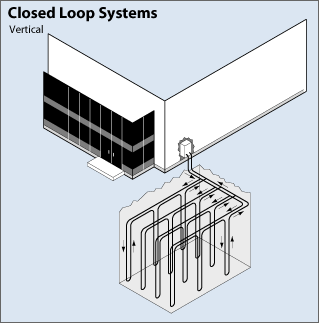
Most closed-loop geothermal heat pumps circulate an antifreeze solution through a closed loop—usually made of plastic tubing—that is buried in the ground or submerged in water. A heat exchanger transfers heat between the refrigerant in the heat pump and the antifreeze solution in the closed loop. The loop can be in a horizontal, vertical, or pond/lake configuration.
One variant of this approach, called direct exchange, does not use a heat exchanger and instead pumps the refrigerant through copper tubing that is buried in the ground in a horizontal or vertical configuration. Direct exchange systems require a larger compressor and work best in moist soils (sometimes requiring additional irrigation to keep the soil moist), but you should avoid installing in soils corrosive to the copper tubing. Because these systems circulate refrigerant through the ground, local environmental regulations may prohibit their use in some locations.

Horizontal

This type of installation is generally most cost-effective for residential installations, particularly for new construction where sufficient land is available. It requires trenches at least four feet deep. The most common layouts either use two pipes, one buried at six feet, and the other at four feet, or two pipes placed side-by-side at five feet in the ground in a two-foot wide trench. The Slinky™ method of looping pipe allows more pipe in a shorter trench, which cuts down on installation costs and makes horizontal installation possible in areas it would not be with conventional horizontal applications.

Vertical

Large commercial buildings and schools often use vertical systems because the land area required for horizontal loops would be prohibitive. Vertical loops are also used where the soil is too shallow for trenching, and they minimize the disturbance to existing landscaping. For a vertical system, holes (approximately four inches in diameter) are drilled about 20 feet apart and 100–400 feet deep. Into these holes go two pipes that are connected at the bottom with a U-bend to form a loop. The vertical loops are connected with horizontal pipe (i.e., manifold), placed in trenches, and connected to the heat pump in the building.

Pond/Lake

If the site has an adequate water body, this may be the lowest cost option. A supply line pipe is run underground from the building to the water and coiled into circles at least eight feet under the surface to prevent freezing. The coils should only be placed in a water source that meets minimum volume, depth, and quality criteria.

Open-Loop System

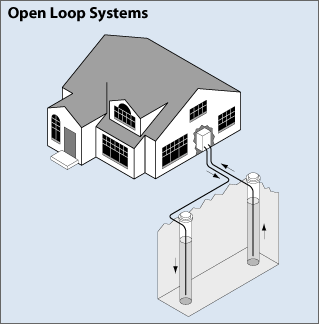
This type of system uses well or surface body water as the heat exchange fluid that circulates directly through the GHP system. Once it has circulated through the system, the water returns to the ground through the well, a recharge well, or surface discharge. This option is obviously practical only where there is an adequate supply of relatively clean water, and all local codes and regulations regarding groundwater discharge are met.

Hybrid Systems

Hybrid systems using several different geothermal resources, or a combination of a geothermal resource with outdoor air (i.e., a cooling tower), are another technology option. Hybrid approaches are particularly effective where cooling needs are significantly larger than heating needs. Where local geology permits, the "standing column well" is another option. In this variation of an open-loop system, one or more deep vertical wells is drilled. Water is drawn from the bottom of a standing column and returned to the top. During periods of peak heating and cooling, the system can bleed a portion of the return water rather than reinjecting it all, causing water inflow to the column from the surrounding aquifer. The bleed cycle cools the column during heat rejection, heats it during heat extraction, and reduces the required bore depth.

To learn more about the different types of geothermal heat pumps please visit Sandium.Com

Article original source from Energy Savers