Friday, June 15, 2012

Testimonials from our Customers

1/28/2012


We needed out duct work worked on and our heater service. We knew that a 20+ old furnace might need to be replaced. Not saying we were excited about this prospect but Sandium helped ease the pain of a new system. I found them through yelp and PG+E. From the moment I spoke to Tyler, I knew he was a cool guy. We scheduled an appointment and he was upfront and honest about all the alternatives. The best way to go was through a rebate program.
The crew that worked on the project was nice and courteous. Chava was the manager and he was great.  A real nice guy and a guy that was looking out for us at every turn. 
The only bummer thing was a rebate that was offered on our unit did not go through. It had expired before we could take advantage of it.


Rox R

January 7, 2012

I had my first introduction to Sandium yesterday.   Nik from Sandium came out to my house to give me a quote request.   I have dealt with dozens of trades people in the past twenty years of living in the bay area and must say that Nik came across as a REAL professional who knows his trade cold.   Given he is one of the co-owners I am not surprised to see the man five star ratings others have posted for Sandium.  They certainly passed the first step I look for a company I want to deal with - do they know their stuff and are are they current, are they courteous, and are they willing to take the time to understand your needs and priorities.

Bay Area, Savvy Consumer


5/12/2012
Sandium installed an air sourced heat pump for us.  A part was defective (from the factory) so we didn't have heat for two days, but I would use them again in a heart beat!  They worked long hours to fix the problem, communicated with us about everything, were very clean and professional.  I've recommended them to friends and they were equally pleased with the work.
6/5/2011
I highly recommend Sandium for A/C work.

When shopping for A/C installation two years ago for my new home, I talked to three different A/C specialists. Sandium stood head and shoulders above the other service providers I spoke to. Nik was the lead pre-sales consultant. He was incredibly professional, timely, excellent at answering all of my questions. He did a thorough on-site inspection before and helped make an excellent recommendation on the specific unit to install in my house. We wanted to make sure we had a unit that would run efficiently and quietly, but we also have a very small patio area in which to place the fan/condenser outside the house. He explained that unit would cost a bit more, but we'd probably be happy with it. And he's right. When our neighbor's A/C is running at the same time, it's louder than ours when we're standing right next to it.

The labor costs were just a bit more expensive than two other service providers I also shopped, but the service, thoroughness and professionalism were well worth it. I was confident that Sandium would do great work, and they did.

One thing I really appreciated with Nik's insistence that the builder of our house provide us with the duct leakage test results before doing the A/C installation. He didn't want to charge us to do it if it wasn't needed, but he said it would save us a lot of money if we were sure the ducts were well sealed before we went forward with the installation. He explained that most builders in new home developments only sample test a few homes but variances can be large from home to home. The builder eventually provided us home-specific the records to show that we were within normal leakage allowances.

On the day of installation, the technician showed up on time, explained everything he was doing, did thorough testing, and was very respectful. He wore shoe covers whenever he needed to come in the house. Everything went smoothly with the installation. During testing, it was discovered that a fuse would need to be upgraded to 30 amps to handle the load of our AC unit. They didn't have one in the truck, but came back the very next day and replaced it, tested it thoroughly, and without any additional charge.

Sandium also saved me money a few months after the A/C was installed when we decided to have paver stones installed in our patio. The paver stone vendor had said that we'd need to have the A/C unit removed and reinstalled for them to do the work. I called Sandium to ask them to do the work, and they said, "No, let me talk to the contractor you're working with. We shouldn't have to do that." They spoke to the paver stone contractor and, sure enough, the paver guys agreed that they could work around the unit and still do a good job. And they did. Sandium saved us $500-600 of labor with that phone call. I'm not sure that another A/C company would have said no to the opportunity for a $500-600 job.

I can't recommend these guys enough.

Healthy Home Audits

We spend so much time in our homes, yet until there is a problem few of us take the time to evaluate just how healthy their home is.  It is a sad, but unfortunate truth, that most people only start to address health issues in their homes when they feel unwell, or when they go to sell the home and they are required to make safety upgrades as part of the real estate transaction. Why wait to fix up your home for the next person when you could enjoy the benefits of living in a healthy home today.

Your doctor can help you deal with your allergy and respiratory problems, but a healthy home inspection can help you uncover unhealthy conditions that may be making you feel unwell.

Your hardwood floors are beautiful, but just below, is a ventilated crawlspace full of dirt, dust, mold, and droppings. Due to the way our homes are constructed, there are plenty of plumbing and electrical openings into the crawlspace that provide a perfect pathway for contaminants to enter your home. 

menu
An estimated 40% of the air in your home starts in your home’s crawlspace. So the key to keeping the air in your home as healthy as possible is to seal penetrations between the home and crawlspace, and to keep the crawlspace as clean as possible. 

A healthy home audit takes a scientific approach to evaluate what is in the air in your home.  We have equipment to sample the air in your home to identify problems such as airborne mold spore concentrations. We test and can monitor humidity and ventilation levels are evaluated. Pollutant sources and pathways that allow airborne pollutants to invade your home.  We use diagnostic monitoring equipment to evaluate swings in temperature and humidity, which uncontrolled can cause indoor mold and dust mite issues.  Sensitive meters are used to identify spikes in airborne particulate and chemical concentrations.  Safety tests are conducted to determine your exposure to deadly carbon monoxide or inadequate ventilation

For a Healthy Home Inspection in the South Bay Area of CA please visit Sandium.Com

Environmental HVAC Retrofitting Services


Hopefully we get smarter as we get older.  This is also true of our heating, ventilation, and air conditioning industry.  Over time our industry has learned how to design and install systems that are safer and more energy efficient.  50 years ago, energy costs were low and we had little understanding of the long-term effect of our environmental footprint.
We take a whole-house approach to make home perform better.  Some call this a “green” approach, but we have seen homes that are called green, but are anything but.  To us, a home is not green unless it performs well.  A home that performs well will
  • provides healthy filtered air to occupants. We used some of the best filtration equipment in the world to keep your lungs happy!  We have staff trained in air quality testing and consulting that can identify and solve indoor air quality problems related to indoor contamination from mold, allergens, dust mite, and volatile organic chemicals (VOCs)
  • uses equipment that is “right-sized” – not over sized.  A well designed heating and cooling system is a system that works behind the scenes to keep you healthy and comfortable. If you notice every time your equipment turns on and off – then something was not designed properly.
  • is comfortable – meaning that the equipment is not noisy and deliver just the right amount of heating and cooling,
  • is energy efficient, meaning that we use energystar equipment and programmable thermostats that installed as part of  whole-house system
For more information please visit Sandium.Com

Geothermal Heat Pumps


Geothermal heat pumps (sometimes referred to as GeoExchange, earth-coupled, ground-source, or water-source heat pumps) have been in use since the late 1940s. Geothermal heat pumps (GHPs) use the constant temperature of the earth as the exchange medium instead of the outside air temperature. This allows the system to reach fairly high efficiencies (300%-600%) on the coldest of winter nights, compared to 175%-250% for air-source heat pumps on cool days.

While many parts of the country experience seasonal temperature extremes—from scorching heat in the summer to sub-zero cold in the winter—a few feet below the earth's surface the ground remains at a relatively constant temperature. Depending on latitude, ground temperatures range from 45°F (7°C) to 75°F (21°C). Like a cave, this ground temperature is warmer than the air above it during the winter and cooler than the air in the summer. The GHP takes advantage of this by exchanging heat with the earth through a ground heat exchanger.
As with any heat pump, geothermal and water-source heat pumps are able to heat, cool, and, if so equipped, supply the house with hot water. Some models of geothermal systems are available with two-speed compressors and variable fans for more comfort and energy savings. Relative to air-source heat pumps, they are quieter, last longer, need little maintenance, and do not depend on the temperature of the outside air.
A dual-source heat pump combines an air-source heat pump with a geothermal heat pump. These appliances combine the best of both systems. Dual-source heat pumps have higher efficiency ratings than air-source units, but are not as efficient as geothermal units. The main advantage of dual-source systems is that they cost much less to install than a single geothermal unit, and work almost as well.
Even though the installation price of a geothermal system can be several times that of an air-source system of the same heating and cooling capacity, the additional costs are returned to you in energy savings in 5–10 years. System life is estimated at 25 years for the inside components and 50+ years for the ground loop. There are approximately 50,000 geothermal heat pumps installed in the United States each year.
To learn more about geothermal systems please visit Sandium.Com
Original source of article Energy Savers

Types of Geothermal Heat Pump Systems


There are four basic types of ground loop systems. Three of these—horizontal, vertical, and pond/lake—are closed-loop systems. The fourth type of system is the open-loop option. Which one of these is best depends on the climate, soil conditions, available land, and local installation costs at the site. All of these approaches can be used for residential and commercial building applications.

Closed-Loop Systems

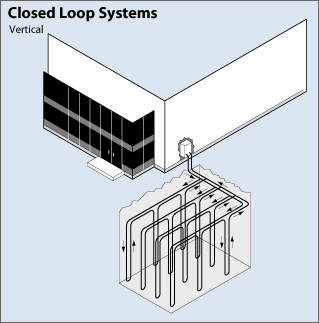
Most closed-loop geothermal heat pumps circulate an antifreeze solution through a closed loop—usually made of plastic tubing—that is buried in the ground or submerged in water. A heat exchanger transfers heat between the refrigerant in the heat pump and the antifreeze solution in the closed loop. The loop can be in a horizontal, vertical, or pond/lake configuration.
One variant of this approach, called direct exchange, does not use a heat exchanger and instead pumps the refrigerant through copper tubing that is buried in the ground in a horizontal or vertical configuration. Direct exchange systems require a larger compressor and work best in moist soils (sometimes requiring additional irrigation to keep the soil moist), but you should avoid installing in soils corrosive to the copper tubing. Because these systems circulate refrigerant through the ground, local environmental regulations may prohibit their use in some locations.

Horizontal

This type of installation is generally most cost-effective for residential installations, particularly for new construction where sufficient land is available. It requires trenches at least four feet deep. The most common layouts either use two pipes, one buried at six feet, and the other at four feet, or two pipes placed side-by-side at five feet in the ground in a two-foot wide trench. The Slinky™ method of looping pipe allows more pipe in a shorter trench, which cuts down on installation costs and makes horizontal installation possible in areas it would not be with conventional horizontal applications.

Vertical

Large commercial buildings and schools often use vertical systems because the land area required for horizontal loops would be prohibitive. Vertical loops are also used where the soil is too shallow for trenching, and they minimize the disturbance to existing landscaping. For a vertical system, holes (approximately four inches in diameter) are drilled about 20 feet apart and 100–400 feet deep. Into these holes go two pipes that are connected at the bottom with a U-bend to form a loop. The vertical loops are connected with horizontal pipe (i.e., manifold), placed in trenches, and connected to the heat pump in the building.

Pond/Lake

If the site has an adequate water body, this may be the lowest cost option. A supply line pipe is run underground from the building to the water and coiled into circles at least eight feet under the surface to prevent freezing. The coils should only be placed in a water source that meets minimum volume, depth, and quality criteria.

Open-Loop System

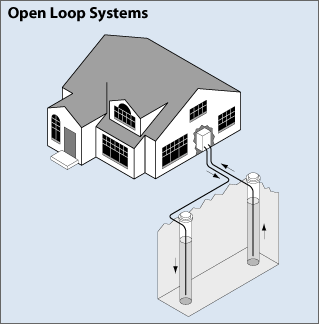
This type of system uses well or surface body water as the heat exchange fluid that circulates directly through the GHP system. Once it has circulated through the system, the water returns to the ground through the well, a recharge well, or surface discharge. This option is obviously practical only where there is an adequate supply of relatively clean water, and all local codes and regulations regarding groundwater discharge are met.

Hybrid Systems

Hybrid systems using several different geothermal resources, or a combination of a geothermal resource with outdoor air (i.e., a cooling tower), are another technology option. Hybrid approaches are particularly effective where cooling needs are significantly larger than heating needs. Where local geology permits, the "standing column well" is another option. In this variation of an open-loop system, one or more deep vertical wells is drilled. Water is drawn from the bottom of a standing column and returned to the top. During periods of peak heating and cooling, the system can bleed a portion of the return water rather than reinjecting it all, causing water inflow to the column from the surrounding aquifer. The bleed cycle cools the column during heat rejection, heats it during heat extraction, and reduces the required bore depth.

To learn more about the different types of geothermal heat pumps please visit Sandium.Com

Article original source from Energy Savers

Benefits of a Geothermal Heat Pump System


The biggest benefit of GHPs is that they use 25%–50% less electricity than conventional heating or cooling systems. This translates into a GHP using one unit of electricity to move three units of heat from the earth. According to the EPA, geothermal heat pumps can reduce energy consumption—and corresponding emissions—up to 44% compared to air-source heat pumps and up to 72% compared to electric resistance heating with standard air-conditioning equipment. GHPs also improve humidity control by maintaining about 50% relative indoor humidity, making GHPs very effective in humid areas.
Geothermal heat pump systems allow for design flexibility and can be installed in both new and retrofit situations. Because the hardware requires less space than that needed by conventional HVAC systems, the equipment rooms can be greatly scaled down in size, freeing space for productive use. GHP systems also provide excellent "zone" space conditioning, allowing different parts of your home to be heated or cooled to different temperatures.
Because GHP systems have relatively few moving parts, and because those parts are sheltered inside a building, they are durable and highly reliable. The underground piping often carries warranties of 25–50 years, and the heat pumps often last 20 years or more. Since they usually have no outdoor compressors, GHPs are not susceptible to vandalism. On the other hand, the components in the living space are easily accessible, which increases the convenience factor and helps ensure that the upkeep is done on a timely basis.
Because they have no outside condensing units like air conditioners, there's no concern about noise outside the home. A two-speed GHP system is so quiet inside a house that users do not know it is operating: there are no tell-tale blasts of cold or hot air.
To learn more about the benefits of geothermal heat pump systems please visit Sandium.Com
Article Original source from Energy Savers

Selecting and Installing a Geothermal Heat Pump System


Heating and Cooling Efficiency of Geothermal Heat Pumps

The heating efficiency of ground-source and water-source heat pumps is indicated by their coefficient of performance (COP), which is the ratio of heat provided in Btu per Btu of energy input. Their cooling efficiency is indicated by the Energy Efficiency Ratio (EER), which is the ratio of the heat removed (in Btu per hour) to the electricity required (in watts) to run the unit. Look for the ENERGY STAR® label, which indicates a heating COP of 2.8 or greater and an EER of 13 or greater.
Manufacturers of high-efficiency geothermal heat pumps voluntarily use the EPA ENERGY STAR label on qualifying equipment and related product literature. If you are purchasing a geothermal heat pump and uncertain whether it meets ENERGY STAR qualifications, ask for an efficiency rating of at least 2.8 COP or 13 EER.
Many geothermal heat pump systems carry the U.S. Department of Energy (DOE) and EPA ENERGY STAR label. Ask your contractor about special financing or incentives for purchasing energy efficient products, including ENERGY STAR qualified products.

Economics of Geothermal Heat Pumps

Geothermal heat pumps save money in operating and maintenance costs. While the initial purchase price of a residential GHP system is often higher than that of a comparable gas-fired furnace and central air-conditioning system, it is more efficient, thereby saving money every month. For further savings, GHPs equipped with a device called a "desuperheater" can heat the household water. In the summer cooling period, the heat that is taken from the house is used to heat the water for free. In the winter, water heating costs are reduced by about half.
Although initially more expensive to install than conventional systems, properly sized and installed GHPs deliver more energy per unit consumed than conventional systems.
And since geothermal heat pumps are generally more efficient, they are less expensive to operate and maintain — typical annual energy savings range from 30% to 60%. Depending on factors such as climate, soil conditions, the system features you choose, and available financing and incentives, you may even recoup your initial investment in two to ten years through lower utility bills.
But when included in a mortgage, your GHP will have a positive cash flow from the beginning. For example, say that the extra $3,500 will add $30 per month to each mortgage payment. The energy cost savings will easily exceed that added mortgage amount over the course of each year.
On a retrofit, the GHP's high efficiency typically means much lower utility bills, allowing the investment to be recouped in two to ten years. It may also be possible to include the purchase of a GHP system in an "energy-efficient mortgage" that would cover this and other energy-saving improvements to the home. Banks and mortgage companies can provide more information on these loans.
There may be a number of special financing options and incentives available to help offset the cost of adding a geothermal heat pump (GHP) to your home. These provisions are available from federal, state, and local governments; power providers; and banks or mortgage companies that offer energy-efficient mortgage loans for energy-saving home improvements. Be sure the system you're interested in qualifies for available incentives before you make your final purchase.
To find out more about financing and incentives that are available to you, visit the Database of State Incentives for Renewable Energy (DSIRE) Web site. The site is frequently updated with the latest incentives. You should also check with your electric utility and ask if they offer any rebates, financing, or special electric rate programs.

Evaluating Your Site for a Geothermal Heat Pump

Because shallow ground temperatures are relatively constant throughout the United States, geothermal heat pumps (GHPs) can be effectively used almost anywhere. However, the specific geological, hydrological, and spatial characteristics of your land will help your local system supplier/installer determine the best type of ground loop for your site:

Geology

Factors such as the composition and properties of your soil and rock (which can affect heat transfer rates) require consideration when designing a ground loop. For example, soil with good heat transfer properties requires less piping to gather a certain amount of heat than soil with poor heat transfer properties. The amount of soil available contributes to system design as well — system suppliers in areas with extensive hard rock or soil too shallow to trench may install vertical ground loops instead of horizontal loops.

Hydrology

Ground or surface water availability also plays a part in deciding what type of ground loop to use. Depending on factors such as depth, volume, and water quality, bodies of surface water can be used as a source of water for an open-loop system, or as a repository for coils of piping in a closed-loop system. Ground water can also be used as a source for open-loop systems, provided the water quality is suitable and all ground water discharge regulations are met.
Before you purchase an open-loop system, you will want to be sure your system supplier/installer has fully investigated your site's hydrology, so you can avoid potential problems such as aquifer depletion and groundwater contamination. Antifreeze fluids circulated through closed-loop systems generally pose little to no environmental hazard.

Land Availability

The amount and layout of your land, your landscaping, and the location of underground utilities or sprinkler systems also contribute to your system design. Horizontal ground loops (generally the most economical) are typically used for newly constructed buildings with sufficient land. Vertical installations or more compact horizontal "Slinky™" installations are often used for existing buildings because they minimize the disturbance to the landscape.

Installing Geothermal Heat Pumps

Because of the technical knowledge and equipment needed to properly install the piping, a GHP system installation is not a do-it-yourself project. To find a qualified installer, call your local utility company, the International Ground Source Heat Pump Association or the Geothermal Heat Pump Consortium for their listing of qualified installers in your area. Installers should be certified and experienced. Ask for references, especially for owners of systems that are several years old, and check them.
The ground heat exchanger in a GHP system is made up of a closed or open loop pipe system. Most common is the closed loop, in which high density polyethylene pipe is buried horizontally at 4-6 feet deep or vertically at 100 to 400 feet deep. These pipes are filled with an environmentally friendly antifreeze/water solution that acts as a heat exchanger. In the winter, the fluid in the pipes extracts heat from the earth and carries it into the building. In the summer, the system reverses and takes heat from the building and deposits it to the cooler ground.
The air delivery ductwork distributes the heated or cooled air through the house's duct work, just like conventional systems. The box that contains the indoor coil and fan is sometimes called the air handler because it moves house air through the heat pump for heating or cooling. The air handler contains a large blower and a filter just like conventional air conditioners.
Most geothermal heat pumps are automatically covered under your homeowner's insurance policy. Contact your insurance provider to find out what its policy is. Even if your provider will cover your system, it is best to inform them in writing that you own a new system.
For more information on selecting and installing geothermal heating systems please visit Sandium.Com
Article original source from Energy Savers